
Precision Over Aggression: Evolving Strategies for Skull Base Tumor Treatment

For benign skull base tumors, the goal is increasingly durable tumor control with functional preservation over maximal resection.
When patients hear the word “cancer,” many want the most aggressive treatment possible. And this was the goal when skull base surgery was just starting out in the ’70s and ’80s, says John S. Oghalai, MD, an otolaryngologist with the USC Caruso Department of Otolaryngology — Head and Neck Surgery, part of Keck Medicine of USC, who specializes in ear and skull base surgery.
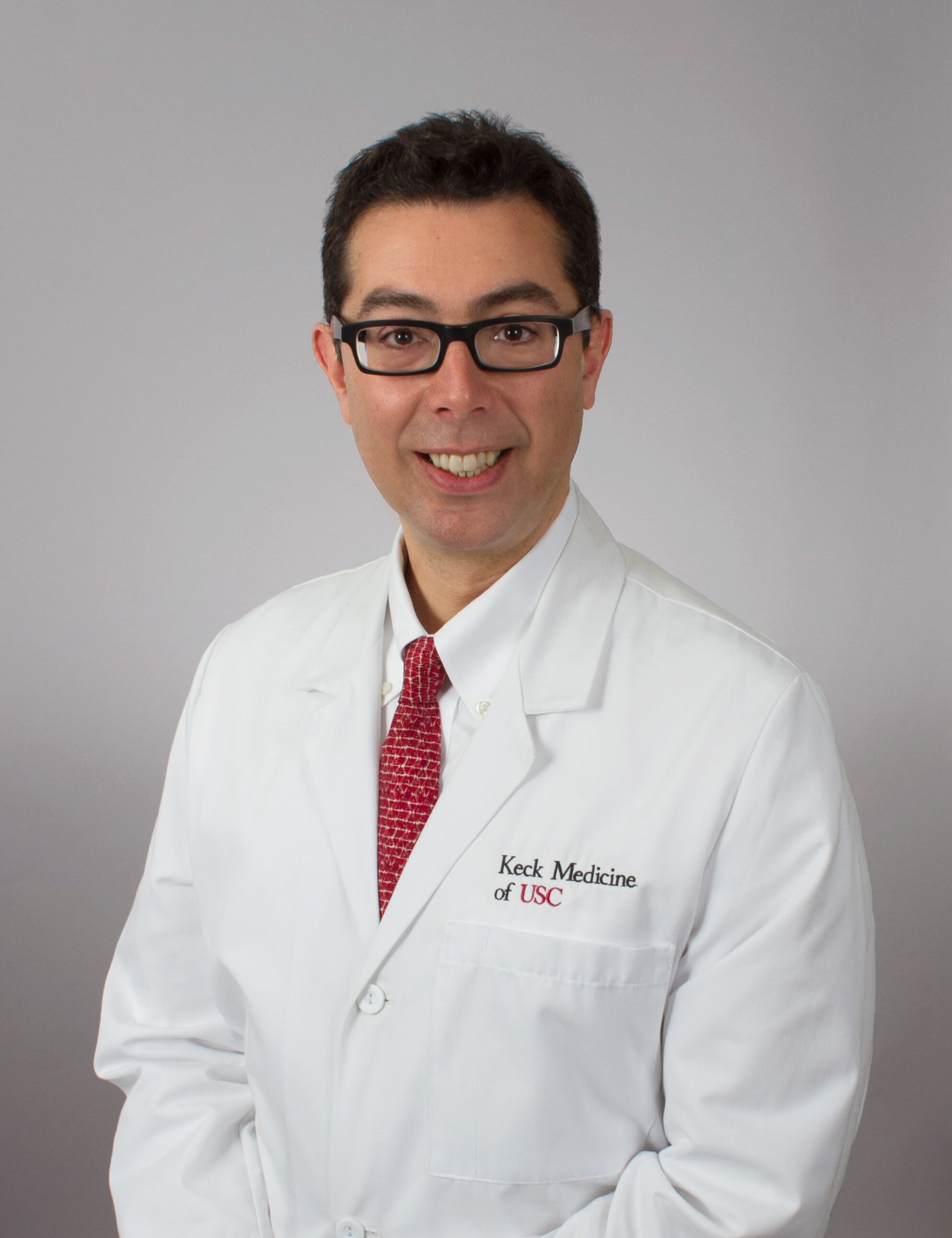
John S. Oghalai, MD
“In the past, surgeons were overly confident, and the goal was to maximally resect tumors and cure the disease,” says Oghalai, who is also the chair of the USC Caruso Department of Otolaryngology – Head and Neck Surgery and the Leon J. Tiber and David S. Alpert Chair in Medicine at the Keck School of Medicine. “But that left patients with a lot of cranial nerve deficits: facial nerve palsy, hearing loss, dysphagia and sometimes double vision, or diplopia. Nowadays, these kinds of outcomes are considered suboptimal.”
Modern management of skull base tumors is increasingly moving from a goal of maximal resection toward a more nuanced balance between tumor control and preservation of neurologic function, Oghalai explains. At Keck Medicine, this approach brings together neurotology, neurosurgery, radiation oncology, neurology, neuroradiology and neuropathology to evaluate each patient and develop an individualized treatment strategy.
“We meet as a team every week and review the new cases to go over imaging and any pathology from previous outside reports if we have it,” Oghalai says. “Then we discuss the case and make a recommendation. From there, the patient can make a final decision as to what they want to do.”
Balancing tumor control with cranial nerve preservation
This shift in treatment strategy is supported by growing evidence for combining function-preserving surgery with stereotactic radiosurgery, particularly in patients with vestibular schwannoma, a type of tumor that arises from the nerve sheath and is generally benign and slow-growing. But surgery for vestibular schwannoma involves dissecting the tumor off the facial nerve.
“Historically, we would try to take out all the tumor and the facial nerve would be left intact anatomically, but it might not work right after surgery because it was bruised or inflamed from the surgical removal of the tumor,” he says. “The facial nerve function would come back, but it might take months.”
A less aggressive dissection may help preserve immediate facial nerve function, with stereotactic radiation available to treat residual or recurrent tumor when necessary. Evidence from research supports this approach: in a 2016 multicenter study co-authored by Oghalai, better immediate cranial nerve VII function was associated with leaving a greater percentage of tumor behind. More recent long-term results published in 2026 from the same study found no independent association between extent of resection and facial nerve outcomes, while showing that larger residual tumors carry a greater risk of regrowth.
The evolution of Gamma Knife technology has further improved treatment. Physicians at Keck Medicine use the latest frameless Gamma Knife system, allowing highly precise stereotactic treatment without the rigid head frame historically associated with Gamma Knife procedures. “Patients can undergo treatment without the frame and leave ten minutes later without really feeling anything, representing a substantial improvement in the treatment experience for the patient,” Oghalai says.
Emerging intraoperative visualization
Investigational technology may further improve the ability to preserve neurologic and auditory function. Researchers at Keck Medicine are developing intraoperative optical coherence tomography (OCT), which can provide depth-resolved visualization of tissue. In skull base surgery, OCT is being used to examine the inner ear and assess structures relevant to vestibular dysfunction and hearing preservation.
The technology may also help surgeons identify cranial nerves and blood vessels beneath the tumor’s surface, Oghalai says. This could be particularly relevant during resection of small vestibular schwannomas, where preservation of the labyrinthine artery is critical to maintaining cochlear blood supply and, potentially, hearing.
When to refer a patient
Oghalai recommends consideration of an academic skull base center whenever surgery or radiotherapy is being contemplated. Observation may remain appropriate when that is the recommended management strategy, but treatment planning can benefit from evaluation by a multidisciplinary team with access to evolving surgical and radiation technologies.
The broader goal is not simply tumor eradication, but durable tumor control while minimizing functional morbidity. Improvements in vestibular rehabilitation have also helped patients recover more rapidly from postoperative dizziness and return to normal function after treatment, he says.
“It’s a common misconception that a patient who undergoes skull base surgery is going to have trouble after treatment. They may live, but they may not enjoy their life. That's not true any longer,” Oghalai says.
USC Caruso Department of Otolaryngology — Head and Neck Surgery
John S. Oghalai, MD, is an otolaryngologist with the USC Caruso Department of Otolaryngology — Head and Neck Surgery, part of Keck Medicine of USC, who specializes in ear and skull base surgery. He is chair of the USC Caruso Department of Otolaryngology – Head and Neck Surgery and the Leon J. Tiber and David S. Alpert Chair in Medicine at the Keck School of Medicine. At the USC Caruso Department of Otolaryngology — Head and Neck Surgery, our otolaryngology doctors provide personalized care for hearing loss, allergies, sinus and nasal disorders, head and neck cancer and a full range of ear, nose and throat conditions.
Learn how our specialists can help with your toughest cases. Visit our Provider Portal to learn more about our programs, capabilities, clinical trials, events and expert insights. Subscribe for free to our monthly Provider Insights newsletter.